


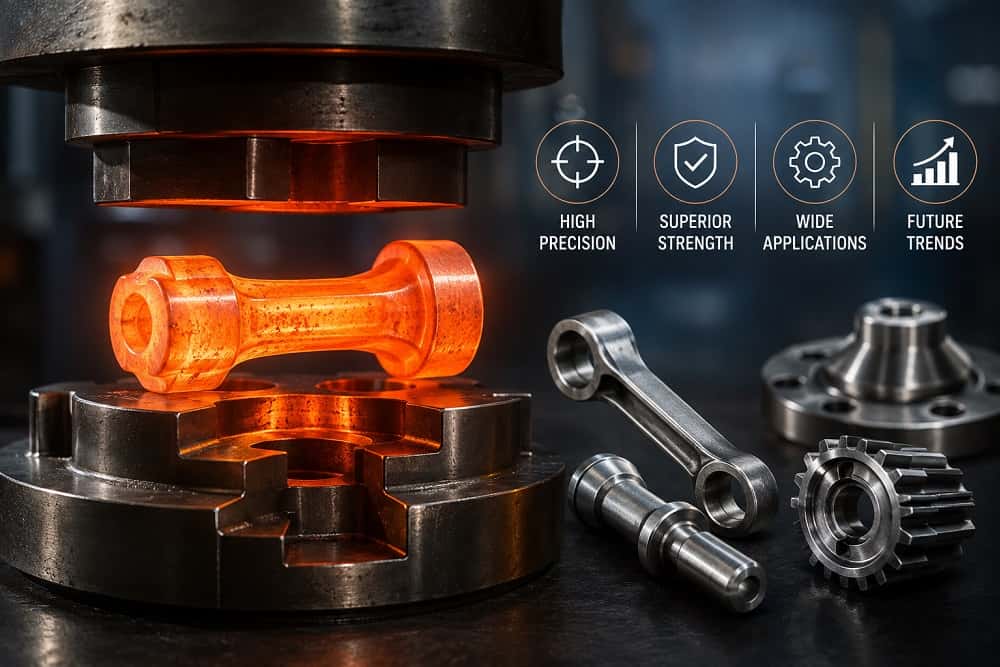
Precision forging refers to an improved method of molding metals, which is capable of producing elements with a very close-to final shape, which have excellent dimensional accuracy, outstanding surface quality, and superb mechanical characteristics, while at the same time using minimum amounts of raw materials.
It is important to use precision forging for the production of durable, precise, and affordable components, which require little machine work in such fields of the industry as automotive, aerospace, defense, medicine, railway industry, and machinery manufacturing. It is specialists in precision forging and many engineering companies that provide precision forging services to obtain complicated forged elements that satisfy various industrial requirements, enhance quality and reduce production expenses.
With the help of precision forging techniques, state-of-the-art technology and practices of manufacture are implemented in the metal-forming field.
Precision Forging Explained: Types, Dimensional Accuracy, and Differences from Traditional Forging
There are six main types of precision forging which are closed die forging, cold forging, warm forging, hot precision forging, isothermal forging, and precision impression die forging, which are used for specific materials, tolerances, and applications. Precision forging is able to achieve high dimensional precision because of precise die design, controlled preparation of the billet, control of temperatures, advanced CNC equipment for forging, advanced simulations of the production process, rigorous quality control, and verification of dimensions after the completion of the production.
Applications of Precision Forging Across Aerospace, Defence, Automotive, Railway, and Heavy Engineering Industries
The process of precision forging has been employed in the production of lightweight and high durable parts of aircraft that include items like landing gear, turbine discs, shafts, and elements of structures manufactured in accordance with strict quality standards. Precision forging involves the manufacturing of durable and efficient parts intended for various kinds of military vehicles, including weapons and missiles, as well as marine vessels and armored machines that require extra durability and high performance. Precision forging is applied in manufacturing heavy-duty wheels, shafts, couplings, flanges, and equipment of factories to ensure them operate even in harsh conditions of work and carry out heavy loads.
Conclusion
Precision forging is a key manufacturing technology that provides the production of durable and sturdy metal components that meet specific dimensional requirements and are cost-effective as well. Thanks to the use of advanced designs of dies, CNC machine-controlled equipment, automation processes, simulation software, and stringent quality control measures, precision forging provides customers with enhanced product consistency and minimal wastage of raw materials as well as machining operations as compared to conventional forging.
Industries require lighter, sturdier, and superior components that increase the chances of growth of precision forging in such fields as automotive industry, aerospace industries, military, railroad construction, heavy engineering, as well as energy industry and industrial production. Advances in Industry 4.0 technologies and different proofs of concept in the use of intelligent technologies of manufacturing that are regarded as sustainable are likely to result in even higher productivity and precision of the production process and competitiveness on a global level.
